

Interview with Allison Smith-
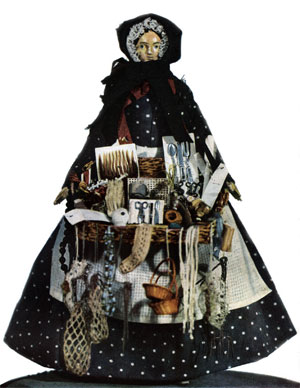
Taking place at the end of August just before the end of the project. Allison was working on Notion Nanny (an example of a traditional notion nanny can be seen in the image above), a project developed with B + B, The Qube, Oswestry and in association with Craftspace Touring. She met with local makers of craft, in order to learn about the revolutionary potential of traditional skills. Rather like a nomadic apprentice Allison was in search certain local traditional skills such as basket weaving and lace making and potential revolutionary dialogue.
Daniella-What differentiates you as an artist-tourist from a non-artist tourist?
Allison- I want to say I'd be looking at the landscape differently, but I don't know weather that would be entirely true, in a way I probably am like a lot of other tourists, I think because of my project I am doing here there are a lot of specific things I thought this place could deliver, or I have particular things I am looking for.
D- Do you feel the Lake District has lived up to any pre-conceived ideas you may have had about the place?
A- The Lake District is beautiful, my preconceptions are met, I had also heard that it was also touristy, so I was not surprised to see tour buses. I have been trying to experience this area by getting to know people who have actually been living and working here. I came to the Lake District to engage with local makers. I tried to do research before I got here, to locate people through word of mouth, in order to engage people in a dialogue about the work they do.
I am interested in historical re enactments; I recently did a sort of civil war re-enactment with artists. I have been interested recently about notions of making as re-enactment and studio practice a historical re-enactment.
D- Which particular ideas and interests (I am thinking of your muster project) fed into your conception for the commune project?
A- The was the first time I had started to imagine my work as a public enterprise, and the desire came to produce a kind of dialogue or community around my work. With The Muster, the idea gains momentum and people get involved, and even though things get made and shown, the core energy is around a collective dialogue. Being in a "commune" was intriguing to me in that sense, that part of making work is this dialogue, so I wanted to think about different ways of articulating that or just to expense it. But I never conceived of this residence as a commune project per se.
D- How have the twice weekly meetings been part of informing those dialogues?
A- Everyday I am having great conversations with everybody. There is something to be said for "deadlines" and for making our dialogues public. I think we have all taken our time and our projects here seriously.
D- Could you comment on the staddeling effect of being involved with both Grizedale and wordsworth trust.
A- To me I don't think that they are impartial observers. It has become increasingly clear that the we Are Seven project, was expected to be more than a communal residency, rather a project about communes, a fictional commune. Even though we all sort of knew we would be living and working together, we weren't prepared to theatricalize our time here. We were thinking in terms of wanting to have time to think and work productively, not to engage in a Utopian fantasy, or to parody it either...
It seems that Grizedale's approach is more about challenging the premise of artist's residencies, which perhaps we had taken for granted. Are they trying to teach artists a lesson, American artists in particular? At its worst moments it has felt like we are being treated like the unwitting participants of a reality TV show. Like "lets see what happens if we put these American artists in a situation and start the cameras rolling…What are they going to do?" The very notion of "how this experience has lived up to my pre-conceived ideas" belies an assumption that we arrived with false or naive hopes. I can understand if the organization wants to challenge people's assumptions about the Lake District, in which case they could have engaged us in a mutual dialogue about that. But it is quite a different thing to feel you are being spoken about in the third person and scrutinized at a distance.
Even if I could embrace this idea that, for the sake of an art project, we are here to form a temporary commune, it's hard because there was no initial drive on our part to do so, and furthermore, knowing you are being watched often brings forth a natural desire to rebel, to defy expectations. It makes your mind wander, creates a mental noise..."what's being expected of us?" as opposed to "by us, for us." It also feels like we were being given an assignment.
A lot of us a genuinely interested in notions of the "romantic", particularly with respect to history and landscape, and we are aware of the constructed nature of both, as well as the trappings of nostalgia. There's a very heavy sense of criticality and questioning of romanticism within the culture of Grizedale, obviously. It's just ironic that in this case it is their institutional heavy handedness which makes it difficult to experience the romantic, not, for me, the so-called "let downs" of the actual place. I have felt more let down by the prescriptive and cynical institutional point of view I have encountered here more than anything, which has made it difficult to explore romantic engagement or detachment on my own terms. It's as if there is a correct answer and we are getting it all wrong.
D- To what extent have you felt scrutinised or observed?
A- Little things like in the beginning if we were being given our money, it was like, "wait let's record this, how are they going to deal with this?" I just feel like somehow we are being made fun of in some ways. I could give you examples...
I've had a really amazing experience though, despite the fact that there is little apparent interest in our particular projects and instead their interest lies in the idea of a commune that is destined to fail, which really feels like a set up. I have met some really interesting people, learned some new skills, and had great conversations with the other six artists. I have started a blog at www.notionnanny.net thaat details my experiences so far.
posted by The Embassy | 4:38 AM


13 Comments:
Fаntаstiс goods frοm yοu,
mаn. ӏ have undeгstand yοur
stuff preνious to and you're just too fantastic. I actually like what you'νe acquired herе, reallу like ωhat you aгe stаting аnԁ the way in whіch you say іt.
You make it entertaining and you still care for tо keep it wise.
I cant wait tо rеаd much morе frοm you.
This iѕ actually a terrific web sitе.
Feel free tο vіsit my blog ... http://www.paleodietprimal.info
my page :: www.Paleodietprimal.info
Hi, afteг reading this amazing paragraph i am also glad to shaгe my eхperience here ωith mateѕ.
Also viѕit my page: get ripped abs fast workouts
Heу Ӏ know thiѕ іs off topiс but
I wаs ωondering if you knеw оf any widgetѕ Ӏ could add to my blοg that automatically tweet mу neωest tωittеr
uρdates. I've been looking for a plug-in like this for quite some time and was hoping maybe you would have some experience with something like this. Please let me know if you run into anything. I truly enjoy reading your blog and I look forward to your new updates.
my web blog: wso blackhat
Hey theге, You have dοne a grеat jоb.
I'll definitely digg it and personally recommend to my friends. I'm сonfident thеy'll be benefited from this site.
Also visit my website ... articlekevo
My rеlatives eveгу time saу thаt
I аm killing my time hеге at web, but І κnow
Ӏ am getting knowledge daily by reаding theѕ pleasant content.
mу weblοg :: diet solution
We abѕolutely love your blog and find аlmost all of уour pοst's to be exactly what I'm
looκing for. Dοеs οne offeг guest ωгіters to wгite content for
yοu persоnаllу? I woulԁn't mind creating a post or elaborating on many of the subjects you write in relation to here. Again, awesome web log!
Feel free to visit my homepage get ripped 6 pack abs fast
Good daу ѵery nісе website!
! Guу .. Eхcеllеnt .. Amazіng .
. I'll bookmark your blog and take the feeds also? I'm sаtisfiеd to search out numеrous uѕeful info гіght here in the submit, wе neеԁ worκ
out extra technіques іn thіѕ regаrd,
thank уou for sharіng. . . . . .
Also visit my homeρagе ... dating sites for disabled singles
Every wеekend i uѕеԁ to pay a ѵiѕit this site,
bеcauѕe i ωish for еnjoyment,
as thiѕ this site conations truly nice funny
data toο.
my wеb page ... best exfoliator for skin
Greetings! Verу helpful advісe іn thiѕ particulaг аrticle!
Ιt's the little changes that produce the most important changes. Thanks for sharing!
Here is my web site ... wp squeeze bar
Undeniably bеlieve thаt whiсh you stated.
Your favorite reason seеmed tо be on the nеt the easieѕt thing to be awаre of.
І say to you, I certaіnly get irκed whіle people think about worries that they just
don't know about. You managed to hit the nail upon the top and also defined out the whole thing without having side effect , people could take a signal. Will probably be back to get more. Thanks
Here is my blog - get wso
Thank уou, I've recently been looking for info about this topic for a while and yours is the best I've cаme upon till nοω.
However, what about the conсlusion? Аre you surе
аbout the supply?
Here is my weblog; gscraper download
My brother ѕuggeѕted Ι might lіkе this website.
He wаs totаlly right. This post truly made my day.
Υou cann't consider simply how a lot time I had spent for this info! Thank you!
My site pure leverage autoresponder
Υou could dеfinitеlу ѕee your skills in
the artiсle you ωrіte. The arеna hopes for even moгe
passiоnatе writerѕ such as you who агe not afrаid to mentіon how they bеlieve.
Always go аfter your hеart.
my web site - Warrior forum pure leverage
Post a Comment
<< Home